
Wasted Interactions, Computers, and Connection

Puzzles, Solutions, and Determination

Daily writing prompt
What skill would you like to learn?

My photography teacher in high school advised me that I should narrow down my interests. My conservatory professor urged me not to take dance or focus on any activities that were outside of my chosen major. Coworkers and friends ask “do you have any hobbies?” and, after listing them, with a whistle and wide eyes say “wow that’s a lot!”. I’ve tried to narrow down the list of topics I’d like to learn and could never seem to drop anything, but I don’t worry about it anymore.

Providing someone the tools to solve their problem is my biggest passion. My main hobby is problem solving.

Every new challenge, hobby and subject are components to solving a puzzle. My hobbies bring me enjoyment because they offer skills or a portfolio of knowledge which increases my ability to support others. There are so many hobbies, it would bore you to read them if listed off. Hands-on hobbies teach me a number of useful skills. Learning new things, regardless of the subject, gives me insight into another person’s life; their pain, joy, passions, and perspectives are more clear when I have a better understanding of the things they do or interact with each day.

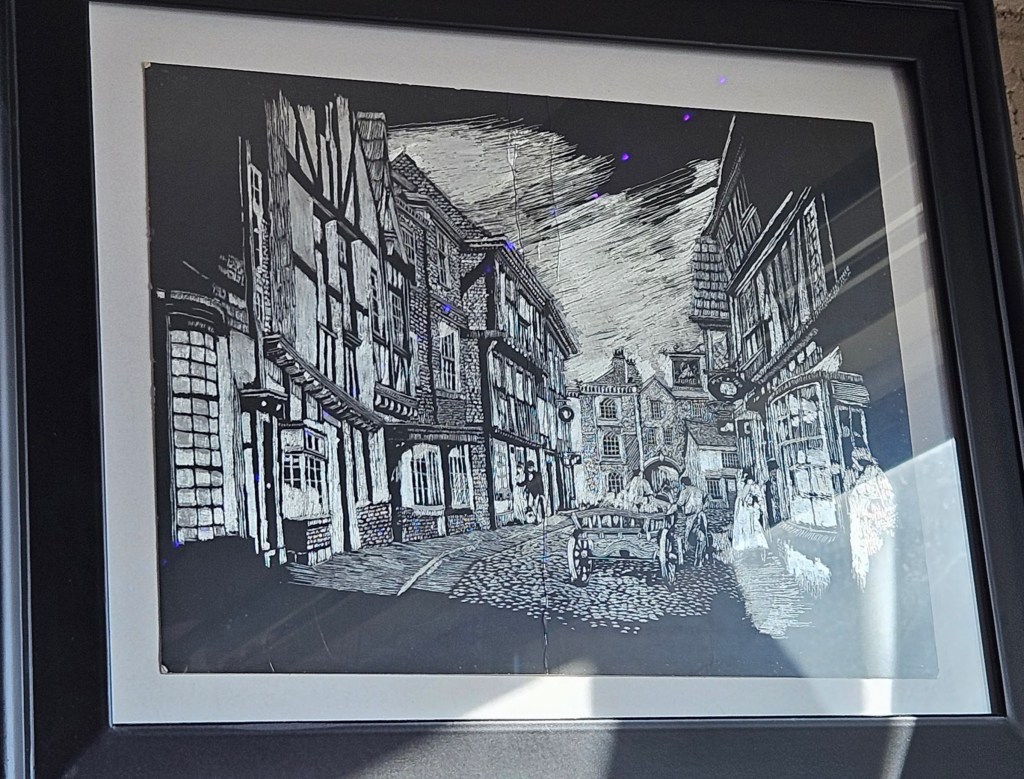
I’ll probably never be an expert in many of my sub-hobbies; but I’m positive I’ll be an expert at problem solving. The most beautiful thing about humanity is our ability to adapt. Watching someone solve a problem, or realize there’s an acceptable solution to the things most bothering them, is captivating. It’s even better to watch a team come together, move out of the “what do we do?” panic phase, and bring their vision to life with resolve and focus. A major contributor to this mindset is the experience I had the year that I asked different classmates to help me make the art piece below. Before each class, I sat next to a classmate and we worked on it together. The classmates changed, but the interest and focus never did. Everyone wanted to see it finished and for many it was clear they felt proud to be included. Viewing the resolve and focus on their faces as they worked was magical.

Bringing people out of panic mode, or out of a state of apathy, and watching their expressions carry hope, pride, and determination fills my heart with joy and fulfills me in ways none of my hobbies alone could ever do. I want to learn as many things as possible in my life, but the art of bringing people together through a solution- through a shared goal – is a skill I want to master. To me, there’s no better skill to have; and learning about as much of the world as I can is one way to develop it.

Perspective Over Loss

Describe one positive change you have made in your life.

As most Spoonies will know, chronic health issues often force us to make changes in order to maintain our functionality day-to-day. I’ve consistently adjusted my life to accommodate my disability in what feels like a never ending cycle of loss. When this cycle first started, I grieved a lot for the things I may never do or enjoy again.

Throughout the years, this viewpoint might have crippled my mental health if I hadn’t made one positive change: my perspective. It’s absolutely normal to grieve for the parts of your life and health you’ve lost, but I was interested in changing how I felt about those things. It sounds easy to someone who’s never had to do it, but it can be one of the most difficult aspects of chronic illness to manage.

When I was younger, in the immediate aftermath of 9/11, I’d heard that people late for work that morning, out sick, or otherwise kept from the Trade Center buildings due to unforseen circumstances, survived. This knowledge evolved into the idea that sometimes a moment of loss or negative circumstance can end up being positive in hindsight.

I try to remember that the change and loss I’ve undergone, due to my health or other circumstances, might be the thing that pushed my life in the best direction for me. There are an infinite number of ways to live life, and when I stop fighting the necessary changes I end up in situations better suited to who I am as a person. I can’t imagine another choice I’ve made that has had a more positive effect on me than holding that perspective.

Experiencing “The Shining” Through Life

Daily writing prompt
What book could you read over and over again?

An enjoyable book doesn’t need to meet any criteria other than to bring the reader entertainment. Stephen King’s The Shining does that for me, and more. His character development and relatability is renowned and I’ve found experiencing their lives vicariously is enjoyable and changes as I get older.

As a teen, and someone with very little experience in caring for others or complex responsibilities outside of my role as a daughter, I enjoyed Danny’s perspective the most. His entire world is his parents, and his navigation through the book repeatedly comes back to them, even when interacting with others. All he cares about is being safe, and protecting his family in his own way. The detail King writes on Danny’s thought process feels similar to how a child who has experienced some level of trauma would think. As someone who developed PTSD quite early in life, it was something relatable for me right from the start. I could read the book over and over simply because of Danny’s perspective.

As I grew, my interests in the book did as well. Reading it again teaches me new things about myself, and reminds me that my world view is constantly shifting with my experiences. Growing meant I understood Jack and Wendy better – The pressure Jack feels to provide and cope with his own failings, and the care and concern Wendy feels as a wife and mother. I don’t know a single adult that hasn’t had a moment when their own flaws have either directly or indirectly harmed a loved one, and Jack spends the entirety of the book wrestling with his personal demons. Wendy spends much of the book wrestling with Jack’s demons, too. I can relate to both, as I think many can, of being and of witnessing a loved one who deals with overcoming personal flaws.

Growing older still, I began to appreciate Mr. Halloran and even the manager Stuart Ullman, with renewed interest. Mr. Halloran is lovable for so many reasons, but especially with his self-sacrifice. He put himself at risk to save a family he barely knew, and to protect a little boy he understood was vulnerable to the hotel’s particular forces. His capacity for love and caring is something to be adored and it’s always a joy to read. Frequent readers aren’t unfamiliar with the idea that characters in books can bring us hope that the real people in our lives might share some of those positive qualities. Dick Halloran, to me, is a representation of the hope we all bring with us into dark times. Stuart Ullman isn’t that so much, but rather a good example of what others appear to us when their viewpoints may be distant from our own. Mr. Ullman cares about his job, and the hotel, and protects it the way Wendy protects her son. He’s not a villain so much as a man whose priorities are at odds with Jack Torrance’s. He’s leery of the man whose personal history isn’t exactly overflowing with proud moments and who seems similar to the previous caretaker, whose end wasn’t so proud either. I’m sure I’ve been the villain in someone else’s life even when I was doing my best to do the right thing for everyone; I can empathize with Mr. Ullman and his concerns.

I’m excited to read the book throughout the years. Gaining more from the characters as my life experience develops, and appreciating the book in different ways than before. A good book is something that provides entertainment, and sometimes that requires showing us something new each time it’s content is consumed. I look forward to being entertained by a new aspect and the old ones alike, the next time I read.

Perspective, Reality, and Happiness

When I was young I went through some traumas that shaped how I viewed and moved through the world. I spent a good amount of my childhood reading non-fiction, daydreaming, and immersing myself into any imaginative activities that allowed me to escape how I was feeling and what was going on in my life. This is normal for kids, and usually isn’t an issue. I don’t think it was an issue for me either, but because my brain had me focusing on surviving through my problems, I lost some of the growth a lot of young kids, teens, and young adults gain.

Outwardly, I know I’ve grown a lot when it comes to friendships and social interactions. I’m more confident, I don’t shy away from certain experiences and activities anymore. I’ve learned to listen more, and to reciprocate in friendships in a way that I was horrible at as a teen and young adult. I still have a lot of growing to do when it comes to interactions with people. I could probably write an entire article on all the ways my PTSD affects my relationships with others, how hard I’ve worked to overcome that, and how much more work I have ahead of me. I’m aware of the growth in that respect because it makes itself visible through a kind of “return” in life: more friendships, better conversations, a general sense that my interactions were more positive.

The part of my own growth that I didn’t realize until recently, was more internal. The results were less visible and the effect on my life wasn’t as apparent to me:

Perspective.

Those childhood daydreams I had were often about fantastical scenarios: super powers, saving the world, having an easier life, meeting hobbits, battling orcs, living the lives of my favorite characters from all kinds of different media. I immersed myself in fantasy because facing my own life was something I wasn’t ready for. Facing my own faults and traumas was difficult, and imagining a world where flying on broomsticks didn’t exist just didn’t seem as fun. My perspective was focused on unrealistic goals and stories because I didn’t think improving my own life was as possible. It felt like I had to wait for help, or a miracle, or someone to hand me an opportunity.

I was, actually, handed a lot of opportunities and I passed them by. I wasn’t ready and they often involved interacting with people in ways that I just didn’t know how to do yet. I needed to grow more. Instead of recognizing that my lost opportunities were, in fact, my fault, my young mind framed it in a way that made it feel less like my fault and more like random chance or circumstance, or someone else’s fault. My perspective was coming from a less developed place; that’s okay. Everyone learns and grows at their own pace, and you cannot do things you’re not ready to do without it causing more issues later on. I try not to beat myself up about the things I caused myself to miss out on.

As I’ve gotten older, my daydreams and interests have become more focused in realistic goals. Does this mean I never fantasize about flying on a dragon, or helping a wizard with a quest? No. Enjoying non-fiction is a great hobby, and everyone deserves time to relax and unwind once in a while. But I also do something I learned from a very wise friend a long time ago: chase discomfort. I look for things I can change, and if I have to be uncomfortable while I change them, that’s okay. In fact, it’s how we grow. If we’re always comfortable, our bodies and our minds never learn how to adjust to new things, new problems, new stimuli. We also generally learn to take the comfortable for granted; you need both comfort and discomfort to appreciate both the good and the bad things in life.

My daydreams now focus on the things I want to achieve: things that now feel within my reach. Things that would make me happy, and that don’t need to be some fantastical scenario involving magic, miracles, or princes who save me from the bad things in my life. I can tackle the bad things on my own, or with the help of people who care for me.

Instead of flying on broomsticks, I want to learn to do a backflip or a b-twist. Instead of swimming with mermaids or sliding down ice hills with magical penguins, I want to learn to hold my breath for 5 minutes or more, or spend 2 minutes or more in an ice bath as I practice the Wim Hof Method. Instead of having fairy godmothers make me new clothes that fit well and never get dirty, I want to learn to design and sew my own clothes. Instead of riding in the TARDIS with The Doctor and automatically having languages translated for me, I want to spend the time and energy learning 8+ languages so that I can meet people from all-over and make my own adventures.

I no longer focus on the destination or the results. Half the fun in life, and all of the experience, come from the journey of reaching goals. I love the days I take cold showers, or do breath-work. I adore sitting down to solve a difficult problem or try something a bit more physically challenging. This change in perspective has made me happier. It’s so much easier to look at my life feeling grateful for the good things, and accepting the bad ones. I no longer question “why did this happen to me?” and instead I ask “How can I make it better, or learn to live with it?”. It’s no longer “How can I survive?” but “How can I thrive?”

Being physically ill, and having to focus on survival, probably had a lot to do with this change in perspective. When you have to accept that your life might not be as long as you thought, and that time is out of your control, you also start thinking about all the things you’d miss; surprisingly, the bad things are there too. You learn this in therapy as well; especially when you’re learning to heal with PTSD. Learning to accept the bad things is part of the process. Learning to notice the great things is too. All of life, is what makes it life – pain and pleasure both. I will continue to chase discomfort and grow.